September 18, 2025
As the expert-recommended, go-to treatment for replacing missing teeth, dental implants in London have skyrocketed in popularity. Now more and more dental implant clinics in the UK are offering patients different types of implants. Single or All-on-4? Immediate load or traditional? Endosteal or Subperiosteal? All the different options, pricing plans, and techniques can be overwhelming.
The good news is that now you can find a more personalised, affordable and reliable treatment plan than ever before. With this guide, you will be able to cut through the noise and make the right decision that best benefits your long-term health.
Types of Dental Implants
Let’s start with an overview of commonly available London dental implant options:
Endosteal Dental Implants
An “endosteal” implant is simply the professional way to describe the type of implant that is inserted into the jawbone. This is the most common type of dental implant patients receive.
Endosteal implants are typically made from titanium and has a body that is shaped like a screw. During the procedure, the implantologist drills the endosteal implant into your jawbone. Once fully healed, the implant will act like an artificial tooth root upon which an abutment and a dental crown are placed to form a prosthetic tooth. Fully supported by the implant, this artificial tooth will look and function just like a natural tooth.
Endosteal implants are sometimes referred to as “single implants.” You can receive more than one endosteal implant depending on how many teeth you are missing and where.
Subperiosteal Dental Implants
Unlike endosteal implants, which are inserted into your jawbone, subperiosteal implants are inserted above the jawbone or into a layer of soft tissue called the periosteum. Subperiosteal implants are recommended for patients who lack the bone density to support endosteal implants. If you are unable to wear dentures or undergo bone grafting to thicken your jawbone, your dentist may recommend these types of implants.
Subperiosteal implants are completely custom-made to match each patient’s unique jawbone structure. This type of implant resembles a metal framework that is inserted into your gumline. Once placed, subperiosteal implants protrude through the gums to hold your artificial teeth in place.
Because these implants are tailor-made for each candidate, clinics typically don’t disclose the costs, unlike for endosteal implants. Your dentist will first have to make an assessment to determine the cost.
Zygomatic Dental Implants
Zygomatic implants (sometimes called Zygoma implants) are inserted into a part of your cheekbone (called the zygomatic bone, hence the name). These implants have a completely different design compared to endosteal and subperiosteal implants.
Unlike the typical endosteal implant, zygomatic implants tend to be considerably longer. These implants are designed to be able to bypass the upper jaw completely and provide a sturdy foundation for artificial teeth.
Zygomatic implants are recommended for patients with severe bone loss, defects, or similar health problems in the upper jaw. Placing zygomatic implants involves a more complex surgical procedure than placing endosteal implants but they are considered just as reliable.
Because zygomatic implants are recommended only in special cases, the pricing will vary depending on the clinic.
Immediate Load Dental Implants
Immediate load is another name for same-day implants. It is less of a type of implant and more of a type of procedure.
With same-day implants, you receive your implant and the prosthetic tooth (which is the crown and the abutment) in one single appointment. You won’t need to take time off to recover and come in for a second procedure to receive the teeth that bring back your smile.
While very convenient, not everyone is a suitable candidate for same-day implants. You will need relatively healthy gums and a dense jawbone to get your prosthetic teeth in one sitting.
All-on-4 Dental Implants
What if you need to replace all your teeth on either the upper or the lower jaw? Instead of receiving an eye-watering 16 implants (that is the number of teeth adults have per jaw), you can do it all with just four!
All-on-4 is a technique for restoring a full set of teeth per jaw with just four implants. Once drilled into dense areas of the jawbone, the four implants will have abutments for supporting artificial teeth.
You can use All-on-4 per arch or both. These implants are cost-effective for restoring multiple missing teeth compared to using more than eight per arch.
Most patients need about 6 months to recover from the initial surgery, after which they can receive the artificial teeth.
All-on-6 Dental Implants
All-on-6 dental implants are largely the same as All-on-4 except that instead of four implants, this method uses six. Also, dentists place All-on-4 implants at an angle, while All-on-6 are placed straight.
All-on-6 is recommended for patients who need extra support for restoring a full set of teeth. Patients may need additional bone grafting before undergoing this procedure. If you have experienced jawbone loss or have had a condition like gum disease, your dentist may recommend All-on-6 over All-on-4.
As this technique uses more implants than All-on-4, it tends to be slightly more expensive.
Mini Dental Implants
As the name suggests, mini dental implants are much smaller in size compared to regular dental implants. They are used to replace missing teeth in narrow gaps, where regular dental implants might be too big.
Mini dental implants are typically used to replace front teeth and make the artificial teeth blend in seamlessly with your natural smile.
Zirconia Dental Implants
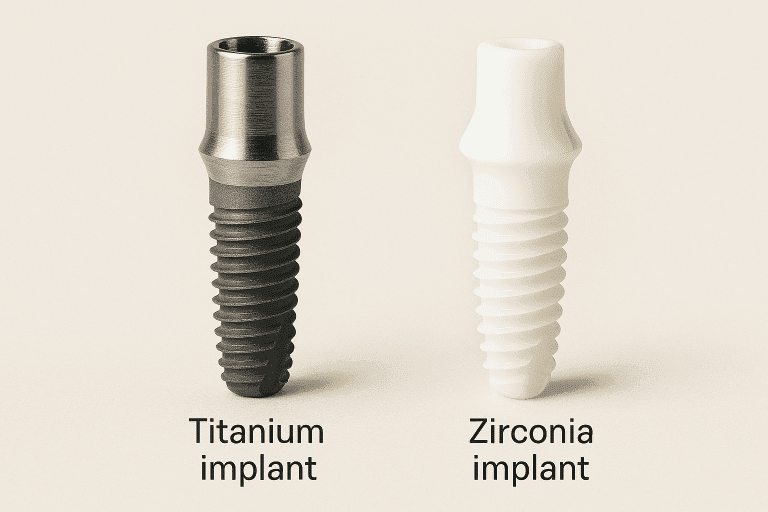
Zirconia is a type of ceramic that dental implants are made of. The typical dental implant is made of titanium, considered the “gold standard”for this treatment because of its biocompatibility. However, some people are allergic to metal or may have jawbone conditions that won’t support metal implants. In such cases, the dentist may recommend zirconia implants instead.
Zirconia dental implants tend to be slightly more costly compared to titanium. Despite the cost, Zirconia is ideal if you have health conditions that prevent you from receiving titanium implants.
How to Find Implants that Suit You the Best
Don’t let the head-spinning number of dental implant options intimidate you. This is what you need to do to choose the implants that are best for you.
Ask for Your Dentist’s Recommendation
Ultimately, it is your dentist’s medical opinion that should determine what implants to choose. When you go in for an implant consultation, a specialist dentist will take X-rays and 3-D scans of your mouth to determine how many implants you need and what kind best suits your current health profile. This is the recommendation you should go with.
Of course, you can ask the dentist about alternatives if affordability or other factors are a concern. For example, if you think you might be allergic to titanium implants, you can inquire about ceramic implants.
Your health comes first. Your dentist is unlikely to recommend implants based on cost alone. Paying now for the right implants will save you money down the road because of higher success rates and reliability.
Zygomatic Dental Implants
Zygomatic implants are inserted into the cheekbone (the zygomatic bone) rather than the jawbone. They have a completely different design from standard implants and are considerably longer. These implants are designed for patients with significant bone loss in the upper jaw where standard implants are not viable.
Learn about Health Risks
Dental implants tend to have high success rates and failure is rare. However, as with most other medical treatments, dental implants come with some health risks. The benefits you receive will far outweigh the risks, but you should be fully informed when you go in for the procedure.
In rare cases, dental implants can lead to post-surgical infections. Your individual health profile determines how exposed you are to such risks. Therefore, you should always give your dentist a full picture of your current health condition to assess the risks implants may pose for you. Your dentist will then discuss your recovery options with you.
Get a Cost Breakdown
The cost of getting dental implants in London varies depending on the type of implant you are getting, how many, and other preparatory procedures you may have to undergo. The clinic you choose should be able to give you a full cost breakdown including all of these before you sit down for the surgery.
In some cases, you may be able to choose a type of implant that lowers the cost of the overall procedure. For example, some types of implants may reduce the need for preparatory procedures like bone grafting, which would save you a few hundred pounds from the final bill.
However, do note that your dentist has the final say in the type of implant you receive, which will be based on your overall health.
Financing the Best Dental Implants in London for You

So, you have spoken to your dentist and chosen the best implant option for long-term reliability. Now you have to finance the procedure! Here is a list of options that you can consider.
Private vs. NHS
Dental implants are typically not covered by the NHS. Therefore, the vast majority of patients need to pay out of pocket. The costs can vary from £1,999 to £25,000, depending on your health requirements.
Don’t despair about the lack of financing from the NHS for this procedure. There are other options to consider.
In-Clinic Financing
As dental implants tend to be expensive, many clinics offer in-house financing plans for incoming patients. The clinic may offer tailored payment plans or work externally with a financier to facilitate payments.
The advantage of going for in-house clinic financing is that you can, for the most part, benefit from reasonable interest rates or even an interest-free period. You can also receive a detailed cost breakdown from the clinic in advance, and they are also more likely to guide you regarding how to finance the procedure long-term from surgery to recovery.
Medical Loans
Medical loans are a last-resort option you can consider if the clinics don’t have financing options for their patients. How beneficial medical loans are will largely depend on where you are getting them from.
Well-known lenders, like Chrysalis, will offer you favourable terms and interest-free periods. But there are also loan sharks to watch out for that will overcharge you in interest. Because of such uncertainty, it’s highly recommended that you go with a clinic that offers financing options rather than one that expects you to rely entirely on third-party financing.
Need Assistance Choosing Dental Implants in London?
You can get back your smile and transform your life with the right type of dental implant. The many options available mean that you can find a good implant option even if you have other health issues. However, choosing the right kind of dental implant is an important decision you cannot make on your own. For help and more information regarding dental implants, contact us at Complete Smiles. We can help you pick the right dentist, clinic, and treatment programme that matches your budget.

Dr. Malavi Sivakanesan (292322)
Dr. Malavi Sivakanesan is the principal dentist and co-founder at Complete Smiles in Harrow, Greater London. She is responsible for establishing the Complete Smiles brand throughout the United Kingdom and Europe and has 5 successful practices under her strong leadership.