December 15, 2025
Earlier this year, a patient came to see me for a routine dental check-up. He was a relatively healthy individual in his early thirties who was quite confident about his dental welfare. He said he’d never had major dental problems as an adult, except for what he described as the “bizarre problem” of a widening gap between his lower incisors.
True enough, his central incisors on the lower jaw were shifting, creating a visible gap. The primary cause was gum recession, a tell-tale gum disease symptom. After a thorough oral examination, I diagnosed him with gum disease and periodontitis. The patient was shocked. He had never suspected he’d ever had gum disease, and he’d had no warning during his last dental appointment, which had been over a year ago.
The prevalence of gum disease and periodontal disease (the advanced form) is on the rise globally, especially among young individuals. Most people are aware of the more obvious signs of gum disease, such as bleeding or swollen gums, inflammation in the mouth, discoloured gum tissue, and tooth sensitivity to hot or cold consumables. However, there are sneakier signs of gum disease that patients, and even some young and inexperienced dentists, tend to ignore.
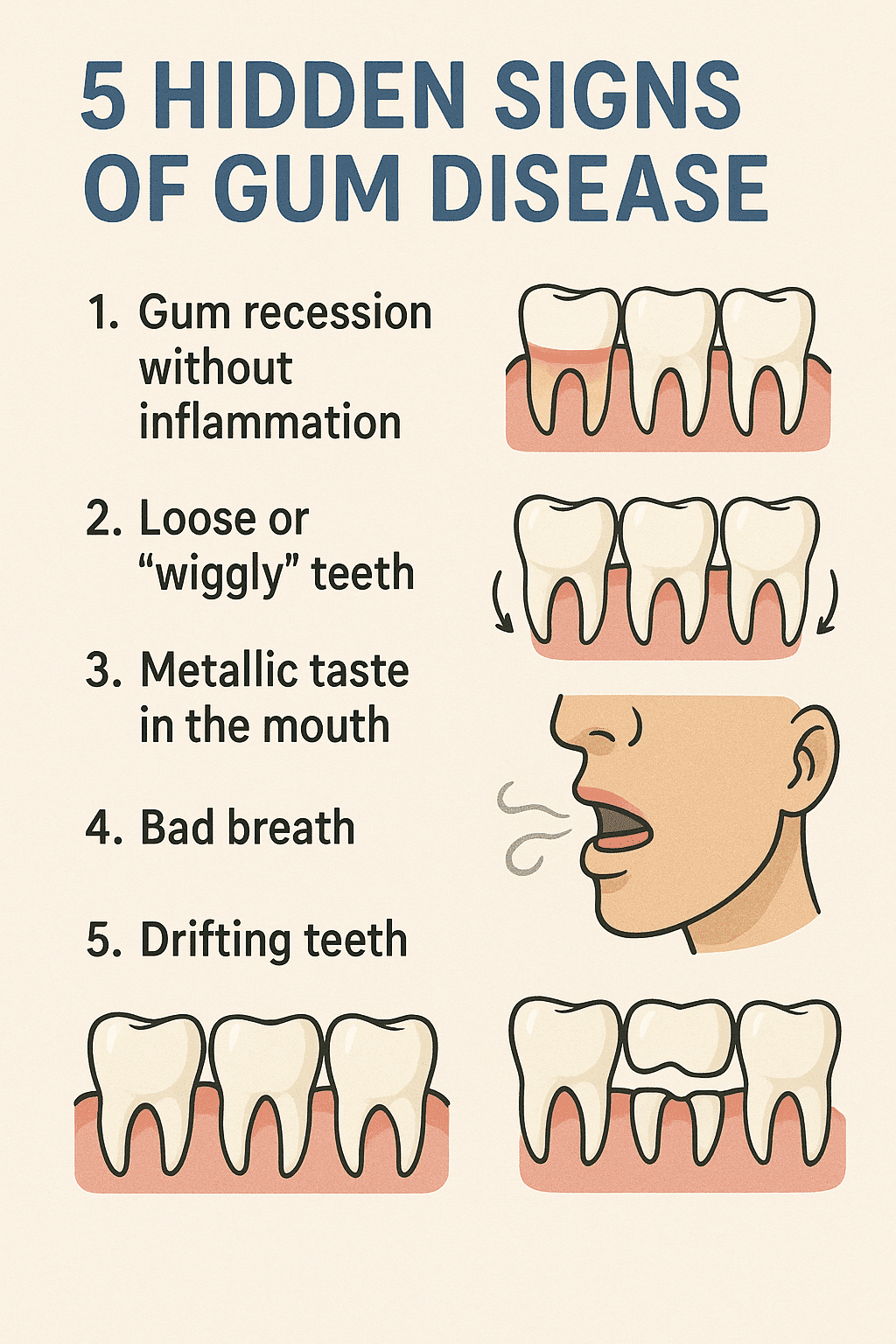
Given how widespread gum disease is, it’s paramount that everyone is aware of the following warning signs to intervene as early as possible:
1. Gum Recession without Inflammation

Usually, gum disease is accompanied by swelling or redness before gum recession occurs. However, it is possible for gum recession to begin without other typical gum disease symptoms. This was the case with the patient I examined. His gums were pink and showed no signs of bleeding, inflammation, or trauma. Regardless, he was experiencing gum recession on the lower jaw.
For patients, gum recession is often difficult to identify unless it occurs around the teeth that are visible when smiling. People may notice their teeth look longer or that their smiles look different than normal and ask a dentist about it.
In severe cases, patients only realise something is wrong when a tooth or two become loose. It’s important to catch the condition before attachment destruction (of the connective tissue that surrounds a tooth) to preserve natural teeth. A routine dental examination is the best way to notice subtle gum recession.
2. Loose or "Wiggly" Teeth
Loose teeth in adults are a serious concern, and most patients think this occurs because of cavities. Mobility in teeth, outside of oral trauma, is an early sign of attachment and bone loss. In some cases, teeth become loose because of severe gum recession. If the condition is caught at this stage, it might be possible to prevent it from worsening and causing bone loss.
Teeth mobility in periodontal disease at times occurs because of "silent" pocket progression. That is, gingival tissue pockets deepening without overt signs of inflammation or discolouration. This is why pocket charting is crucial even when the gingival appearance is relatively normal in patients who present with loose teeth.
3. Metallic Taste in Mouth

Chronically feeling a distorted taste in the mouth (dysgeusia) can happen for a number of reasons, but increasingly it is becoming one of the gum disease symptoms. Connecting dysgeusia to gum disease can be tricky because of its many origins. However, if it is accompanied by considerable plaque buildup, poor oral hygiene, and pocket formation, then it can be ruled as gum disease.
It is recommended to check for subgingival inflammation (infection under the gums) in patients who complain about chronic dysgeusia. Some inflammation with pocket formation is to be expected with dysgeusia caused by gum disease. However, dental professionals should thoroughly discuss medical history and lifestyle habits with patients to rule out other possibilities.
4. Bad Breath (Halitosis)
Most people are aware of the connection between bad breath and poor oral hygiene. In some cases, bad breath is also a sign of gum disease. Patients with periodontitis are more likely to have chronic bad breath than those without. Bad breath in gum disease sufferers primarily occurs because of the same bacteria that cause inflammation.
Bad breath gets its odour from gases called volatile sulphur compounds (VSCs), which are produced by anaerobic bacteria like Porphyromonas gingivalis. The same bacteria are responsible for causing calculus, gum inflammation, and recession in people with gingivitis. These microorganisms thrive in subgingival (under gum) pockets. The deeper the pockets, the worse the bad breath will be.
5. Drifting or Shifting Teeth

Tooth mobility that creates gaps is a sign of loss of periodontal support caused by gum disease. While drifting can affect any tooth, incisors are particularly vulnerable to this condition. Patients are also most likely to notice drifting teeth if it affects the incisors, altering smiles.
Most people don’t realise tooth mobility is a serious problem and instead seek cosmetic dental treatments, like veneers, to hide the gap. Drifting teeth eventually become loose teeth, at which point the gum disease is most likely to cause bone loss. When a patient complains about a tooth gap that hasn’t been there since childhood, it’s essential to perform a comprehensive oral examination to rule out gingivitis.
Gum disease is largely a comorbid condition. Those who have it are likely to have other medical conditions, such as diabetes, metabolic syndrome, heart disease, or be at serious risk of such diseases.
When diagnosing gingivitis or periodontitis, taking a good look at the overall medical picture of a patient will help dentists avoid overlooking more unusual signs of these conditions. For patients, being aware of lesser-known signs of gum disease is key to seeking dental help before it’s too late.
Can Gum Disease Kill You? Book a Professional Check-up to Get Help Early
Conditions like gum disease can be effectively treated when caught early. While an at-home check-up is good, it’s not a substitute for a proper oral examination conducted by a qualified dental professional.
Getting a dental check-up, at least once a year, can catch early signs of gum disease before it deteriorates into periodontal disease. You can call Complete Smiles to arrange a consultation any day of the week. Urgent appointments are available if your gums are bleeding or if you are experiencing severe pain.

Dr. Pedro Coelho (297274)
Ola! I'm Pedro, a dedicated dentist with a remarkable journey that spans borders and transcends conventional dental care. Born in the picturesque country of Portugal, my path in dentistry has been driven by a profound desire to make a difference in people's lives.